Newsletter Subscribe
Enter your email address below and subscribe to our newsletter

 ByJohn A
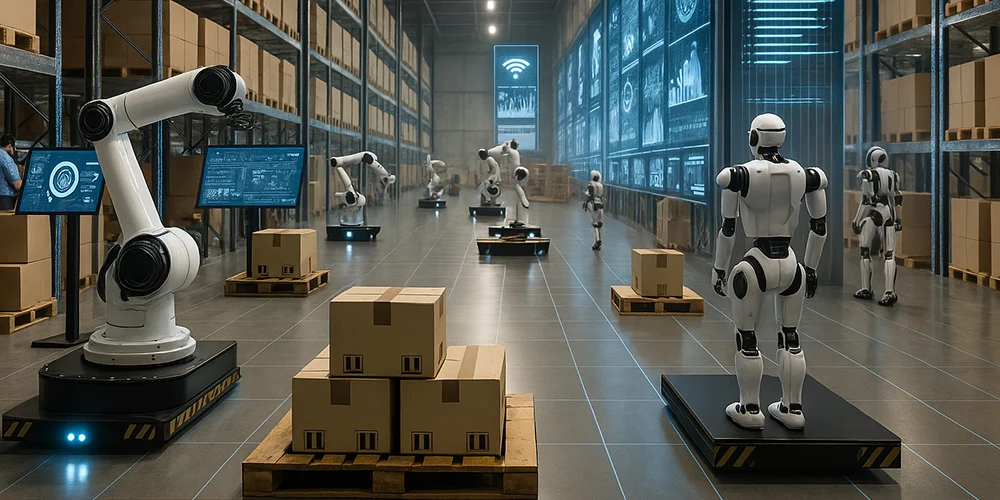
AI-driven warehouse management transforms complex processes into visible, fast, and accurate systems. Data dashboards reveal throughput, cycle times, and error rates, guiding rapid, evidence-based decisions. Robotics streamline picking and stacking, while energy optimization trims overhead. Demand forecasting and inventory optimization align stock with demand, reducing safety stock and accelerating turnover. Fulfillment AI refines routing, picking, and replenishment, enabling scalable, repeatable workflows that promise measurable ROI—yet real-world tradeoffs and integration challenges demand close scrutiny as operations evolve.
AI-driven warehouse management transforms everyday operations into a tightly orchestrated system of visibility, speed, and accuracy. Data-driven dashboards quantify throughput, cycle times, and error rates, enabling rapid, evidence-based decisions. Warehouse robotics automate picking and stacking, while energy optimization lowers overhead. The approach prioritizes measurable outcomes, scalable processes, and operational freedom—empowering teams to reallocate effort toward value-added activities without compromising reliability.
Effective demand forecasting and inventory optimization build on the visibility and automation described previously. AI analyzes historical patterns, seasonality, and external signals to forecast demand with quantified confidence. This enables precise stock levels, reduced safety stock, and faster turnover.
Outcomes include lower carrying costs, higher service rates, and improved cash flow. Demand forecasting and inventory optimization empower teams seeking operational freedom and measurable efficiency gains.
See also: kronosshort
AI-enabled fulfillment optimizes routing, picking, and replenishment to minimize travel time and handling while maximizing pick accuracy. In practice, autonomous routing reduces congestion, while dynamic picking sequences improve throughput. Replenishment scheduling aligns stock with demand signals, limiting stockouts and overstocks. Together, ai enabled systems reinforce inventory optimization, delivering measurable gains in accuracy, throughput, and cycle times without sacrificing operational freedom.
Measuring impact in warehouse AI initiatives centers on quantifiable ROI, safety outcomes, and a disciplined path of continuous improvement.
The analysis targets measurable efficiency gains, reduced incident rates, and data-driven process refinement.
Insight gaps and adoption barriers shape implementation decisions, guiding robust benchmarks and transparent reporting.
Outcomes-focused metrics align stakeholders, enabling scalable, purposeful deployment and ongoing optimization across operations.
The data used by AI in warehouses is safeguarded through robust privacy safeguards and clear data ownership policies, ensuring accountability, compliance, and controlled access while optimizing efficiency and outcomes with transparent, outcome-driven security measures for freedom-minded operators.
AI cannot fully replace human workers in warehousing. Data-driven analysis shows ongoing AI ethics and human-robot collaboration drive safety, adaptability, and efficiency, delivering outcomes while preserving individual autonomy and freedom within optimized, compliant operations.
The upfront cost encompasses hardware, software, and integration, while ongoing cost covers maintenance, cloud fees, and updates. Data-driven, outcome-focused analysis shows efficiency gains often justify expenditures; scalable solutions support operational freedom with measurable ROI and reduced risk.
AI handles data quality and sensor failures by implementing data quality remediation processes and sensor fault tolerance, ensuring reliable inputs. It minimizes disruption, maintains operational visibility, and supports freedom-seeking outcomes through data-driven, efficient, outcome-focused performance.
Required skills include: skills mapping, integration planning, data governance, system interoperability; professionals continuously optimize workflows, ensure compliant data practices, and align AI capabilities with business outcomes, delivering measurable efficiency gains while preserving autonomy and adaptability for evolving warehouse operations.
AI transforms warehouse operations from guesswork to measurable certainty. Juxtaposing manual, error-prone timelines with data-driven dashboards highlights stark efficiency gains: longer cycle times shrink against precision metrics; high-touch processes yield to automated routing and picking; safety incidents fall as predictability rises. Yet growth remains tangible—ROI accelerates as demand forecasts tighten inventory turns and replenishment becomes repeatable. In this contrast, the future is not abstract, but quantified, optimized, and continuously improved.